


The construction works of the Cardiovascular Surgical Center within the Institute for Emergency Cardiovascular Diseases and Transplantation Târgu Mureș have reached an important milestone: the structural frame of the building and, for the most part, the structural façades were completed in just six months from the work start order.
The construction complex will feature a main building composed of a basement, semi-basement, ground floor, five floors, a technical floor, an energy block, a medical gases block, and an outdoor parking area. The edifice is located within the hospital complex of the Târgu Mureș County Clinical Emergency Hospital.

How was this possible?
Through technological solutions different from classical ones, high-performance management, rigorous planning of resources, a constantly updated and monitored schedule, extended working hours on site, experience, construction expertise, and the ability to integrate parts of the building simultaneously.
One of the key solutions that enabled the structural frame to be completed in such a short time was the prefabrication of elements, including the exterior façade, in CONA’s own production facilities. The structure is predominantly made of prefabricated reinforced concrete, produced in-house, supplemented by steel structures and cast-in-place reinforced concrete on site.
All these systems can be implemented in record time, while complying with legislation, only when there is perfect synergy between designer – prefabricator – technology – and site management.

Exterior closures
The exterior closures consist of prefabricated concrete panels, factory-equipped with architectural façade components (windows, ventilated façade, accessories). These allowed the building envelope to be completed simultaneously with the structural frame.

Structural frame and façade, produced in CONA’s own factories
The columns, beams, exterior prefabricated concrete panels, ventilated façade system, and joinery were produced and installed in CONA factories.
The sustained team effort and excellent coordination between all departments — design, industrial production, site management, logistics, commercial, procurement, and finance — contributed to achieving this performance.
Technologies used: high-capacity cranes and continuous activity, day and night
Once the structural elements reached the construction site, a new challenge arose: extremely limited space for site operations. This required adapting and overcoming technological limitations. Oversized transport equipment and cranes with higher-than-usual performance and capacity were involved to meet the technological demands.
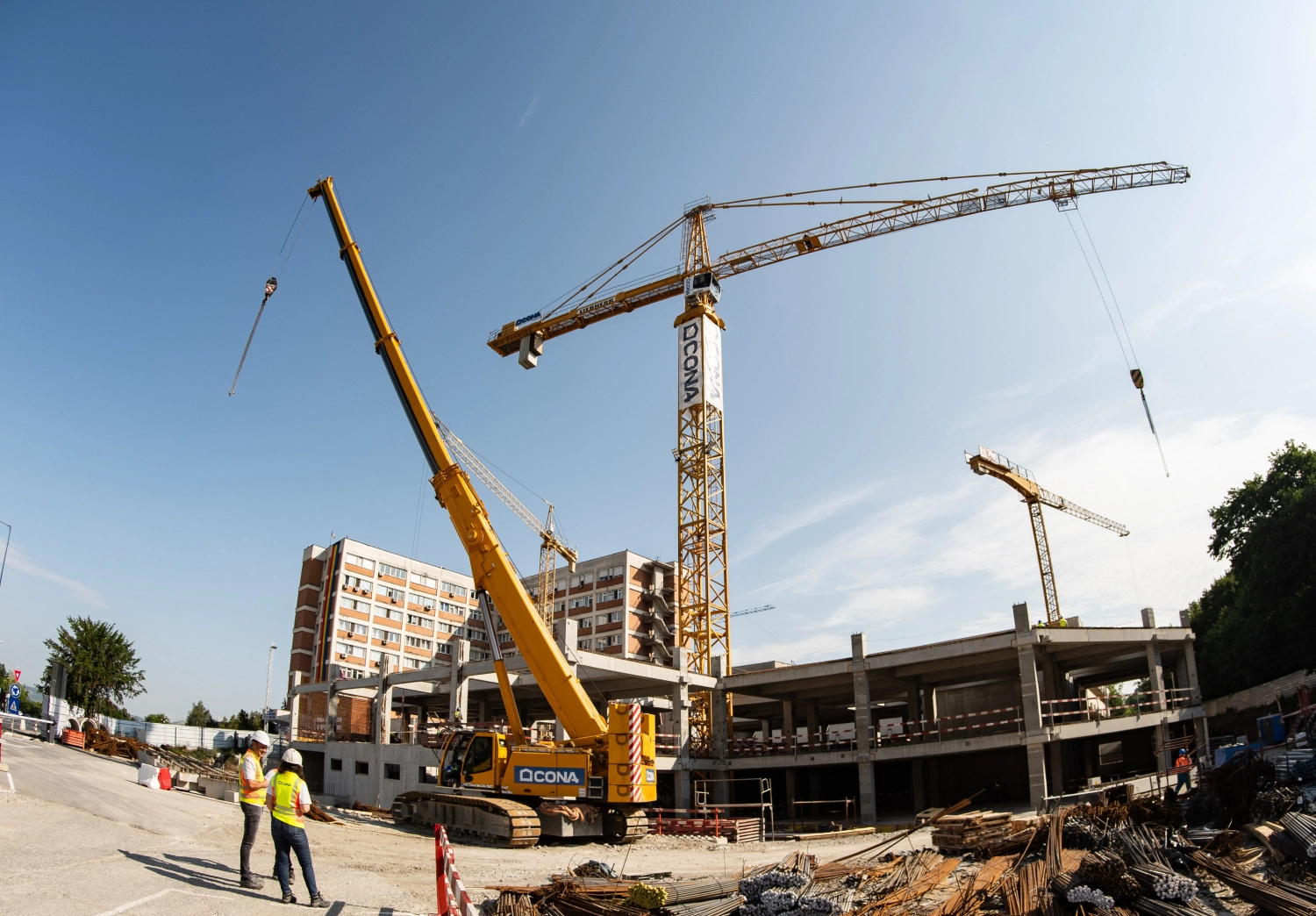
Producing parts of the building in dedicated manufacturing bases significantly contributed to maintaining the project’s eligibility for PNRR funding.
Given the height of the building and its many levels, choosing a traditional cast-in-place concrete solution would have at least doubled the time required for completing the structural frame. However, the prefabrication of many building components and their assembly in production facilities made it possible to maintain the project as viable under PNRR financing.
In numbers – the building in 6 months:
- ~4,500 m³ of prefabricated reinforced concrete elements
- ~8,000 m³ of cast concrete in infrastructure and superstructure
- ~1,000 tons of reinforcement steel
- ~220 tons of steel structure
- ~4,500 m² ventilated façade
- ~1,200 m² aluminum joinery
Construction management:
- Innovative solutions for optimizing space
The execution of this project brought us great team satisfaction, but also many challenges, one of them being the very limited space. Among other functional improvements due to space constraints, to maximize the use of the newly built area, we allocated the electrical plant — which provides the required electrical power — to an adjacent underground unit, over which a green space will be created. This allowed us to combine spatial constraints and urban limitations with a practical solution that ensures efficient resource allocation while preserving the designated green areas.
Additionally, for HVAC equipment (AHUs, chillers, heating plants, pumping groups) serving the entire hospital, we implemented the solution of creating a technical floor on the building’s roof.
- Team synchronization and responsibility
Our goal was to coordinate all preliminary stages with industrial production and on-site assembly as efficiently as possible, based on the execution schedule and strict internal quality standards. All deliveries were carefully scheduled so that prefabricated elements were installed immediately upon arrival. At peak times, we coordinated over 250 workers working simultaneously on the project.

Even though many young construction engineers were part of the execution and management teams, they understood the importance of the project and approached it with responsibility, professionalism, and seriousness, fulfilling all legal and contractual obligations.
Another challenge was ensuring safe working conditions during construction and installation, without endangering the lives and safety of workers, considering the limited space, intense work rhythm, and multi-level structure. Safety rules were rigorously followed, collective protective measures were carefully implemented and verified, and the site was continuously monitored by certified occupational health and safety inspectors.
“Every day on site was a lesson in coordination and patience. The limited space and accelerated pace forced us to find quick and efficient solutions, and constant communication between us and the Institute for Emergency Cardiovascular Diseases and Transplantation helped us make effective decisions at each stage. This project challenged us and showed us how important collaboration is in turning plans into reality.” – project execution manager.
Solid experience in complex projects
The Cardiovascular Surgical Center project in Târgu Mureș represents an important accomplishment for the CONA team, based on the experience accumulated in previous projects with similar structural solutions. We mention here the first project completed over 15 years ago and another hospital financed through PNRR:
- Multilevel Parking in Mănăștur, Cluj-Napoca: Completed in 2009 in only eight months, with a height regime S1+S2+GF+6F+Terrace, including 470 parking spaces. Its innovative structural system, assembled in just a month, was awarded the following year by AICPS.
- Extension of Bistrița County Emergency Hospital: A major healthcare project completed in 2025, with a surface of 12,000 sqm, involving the construction of a new four-story building and modernization of the existing infrastructure.
General project information
The contract was awarded to a consortium led by CONA Operations, which is responsible for building the entire structure. The beneficiary is the Institute for Emergency Cardiovascular Diseases and Transplantation Târgu Mureș. The contract includes design (PT, DE, DTAC, DTOE, permits), execution, and technical assistance, and is financed through the National Recovery and Resilience Plan (PNRR).
The new medical building includes the following functions:
- Basement: parking, firefighting system, pre-treatment plant, civil protection shelter
- Semi-basement: outpatient services, café, pharmacy, administrative offices, radiology and imaging
- Ground floor: day hospital, administration, sterilization and laboratory
- 1st floor: ICU and Cardiology III, pediatrics
- 2nd floor: Cardiology I and adult acute care
- 3rd floor: cardiovascular surgery for adults and children
- 4th floor: functional testing labs, USTACC, electrophysiology labs and Cardiology II
- 5th floor: ICU and operating block
- Technical floor: HVAC equipment, chillers, heating plant, photovoltaic solar panels
CONA Management Team: “This building can be summed up in a few simple words: it is for people, especially for those who, in difficult moments, will benefit from treatment and interventions at the highest standards and in the best conditions. The project went through difficult stages, one of them being the risk of being removed from PNRR funding if it had not reached an advanced stage of maturity.
We managed to convince through facts and results, and this was reflected in the inclusion of this essential project among those financed by PNRR. We thank the Ministry of Health for their trust and support, as well as the management team and the doctors involved in Târgu Mureș.
The Cardiovascular Surgical Center is the result of solid experience accumulated over more than 20 years in large-scale construction projects, a consolidated team of managers, specialists, engineers, designers, integrated production facilities, and a responsible, professional, and attentive approach at every stage. Every phase was rigorously planned and coordinated, and the exceptional collaboration with the Institute’s team made it possible to overcome all challenges.
The result will be a solid building at high standards, serving the community and standing as an example of excellence, dedication, and professional maturity.